Deploying Wazuh agents on macOS endpoints
The Wazuh agent runs on the endpoint you want to monitor and communicates with the Wazuh manager, sending data in near real-time through an encrypted and authenticated channel.
Before you start, create an enrollment token on the Wazuh manager, as described in Generate the enrollment token. The endpoint must reach the Wazuh manager on port 1517/TCP.
Note
You need root user privileges to run all the commands described below.
To start the installation process, download the Wazuh agent according to your architecture:
Intel: wazuh-agent-5.0.0-rc1.intel64.pkg. Suitable for macOS Sonoma (14) and Sequoia (15) on Intel.
Apple Silicon: wazuh-agent-5.0.0-rc1.arm64.pkg. Suitable for macOS Sonoma (14) and Sequoia (15) on Apple Silicon.
Select the installation method you want to follow: command line interface (CLI) or graphical user interface (GUI).
Run the following command to deploy the Wazuh agent on your endpoint.
Replace
<ENROLLMENT_TOKEN>with the token you created in Generate the enrollment token, and<AGENT_NAME>with a name for this endpoint that no other agent uses, for example, its host name. If you omitWAZUH_AGENT_NAME, the agent enrolls under the endpoint's host name.# curl -O https://packages-staging.xdrsiem.wazuh.info/pre-release/5.x/macos/wazuh-agent-5.0.0-rc1.intel64.pkg # echo "WAZUH_ENROLLMENT_TOKEN='<ENROLLMENT_TOKEN>'" > /tmp/wazuh_envs && echo "WAZUH_AGENT_NAME='<AGENT_NAME>'" >> /tmp/wazuh_envs && installer -pkg wazuh-agent-5.0.0-rc1.intel64.pkg -target /
# curl -O https://packages-staging.xdrsiem.wazuh.info/pre-release/5.x/macos/wazuh-agent-5.0.0-rc1.arm64.pkg
# echo "WAZUH_ENROLLMENT_TOKEN='<ENROLLMENT_TOKEN>'" > /tmp/wazuh_envs && echo "WAZUH_AGENT_NAME='<AGENT_NAME>'" >> /tmp/wazuh_envs && installer -pkg wazuh-agent-5.0.0-rc1.arm64.pkg -target /
For additional deployment options such as agent group, see the Deployment variables section.
Note
Alternatively, if you want to install an agent without enrolling it, omit the deployment variables. To learn more about the different enrollment methods, see the Wazuh agent enrollment section.
Start the Wazuh agent to complete the installation process:
# launchctl bootstrap system /Library/LaunchDaemons/com.wazuh.agent.plist
In the Wazuh dashboard, Agents management > Summary lists the agent as Active.
The installation process is now complete, and the Wazuh agent is now successfully running on your macOS endpoint.
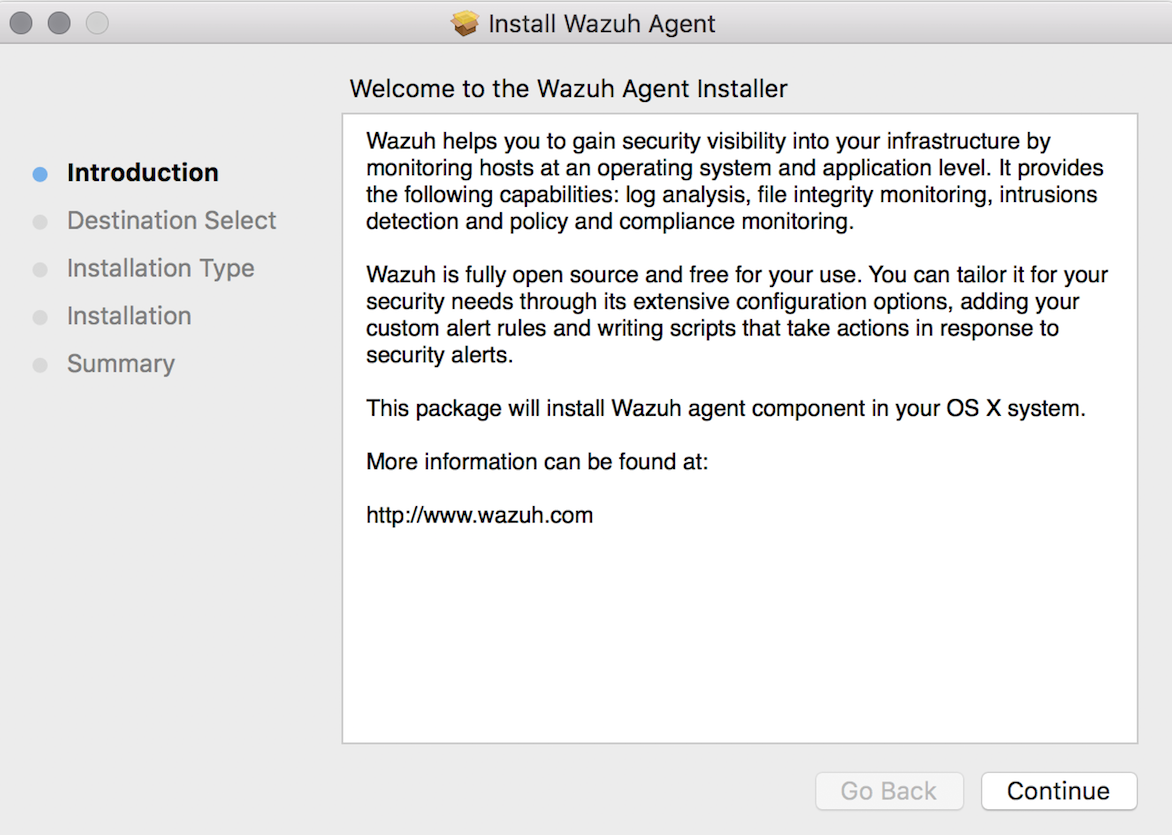
To install the Wazuh agent on your system, run the downloaded file and follow the steps in the installation wizard. If you are not sure how to answer some of the prompts, use the default answers.
Enroll the Wazuh agent before you start it. An agent installed without an enrollment token doesn't start until you enroll it. Save the token you created in Generate the enrollment token to a file, enroll the agent, and delete the file:
# (umask 077 && echo '<ENROLLMENT_TOKEN>' > <TOKEN_FILE_PATH>)
# /Library/Ossec/bin/wazuh-agent-auth --token-file <TOKEN_FILE_PATH>
# rm -f <TOKEN_FILE_PATH>
Start the Wazuh agent to complete the installation process:
# launchctl bootstrap system /Library/LaunchDaemons/com.wazuh.agent.plist
In the Wazuh dashboard, Agents management > Summary lists the agent as Active. The installation process is now complete, and the Wazuh agent is successfully running on your macOS endpoint.
By default, all agent files are stored in /Library/Ossec/ after the installation.