How it works
The Wazuh File Integrity Monitoring (FIM) module runs on the Wazuh agent, enabled and preconfigured by default. It monitors files and directories using scheduled scans or real-time monitoring, detecting changes at fixed intervals or the moment they occur. Although the default configuration provides basic monitoring, review and customize it to meet your environment's requirements.
The FIM module stores checksums and other attributes of monitored files in a dedicated database on the monitored endpoint. During scans, it compares the current file checksums and attributes with the previously stored values to identify additions, modifications, and deletions. When changes are detected, the Wazuh agent reports them to the Wazuh manager, where they are processed and forwarded to the Wazuh indexer. If an event matches a detection rule, Wazuh generates a security finding.
The Wazuh agent uses a local SQLite database to store the current state of monitored files. The Wazuh agent FIM database is located at:
C:\Program Files (x86)\ossec-agent\queue\fim\dbon Windows./var/ossec/queue/fim/dbon Linux./Library/Ossec/queue/fim/dbon macOS.
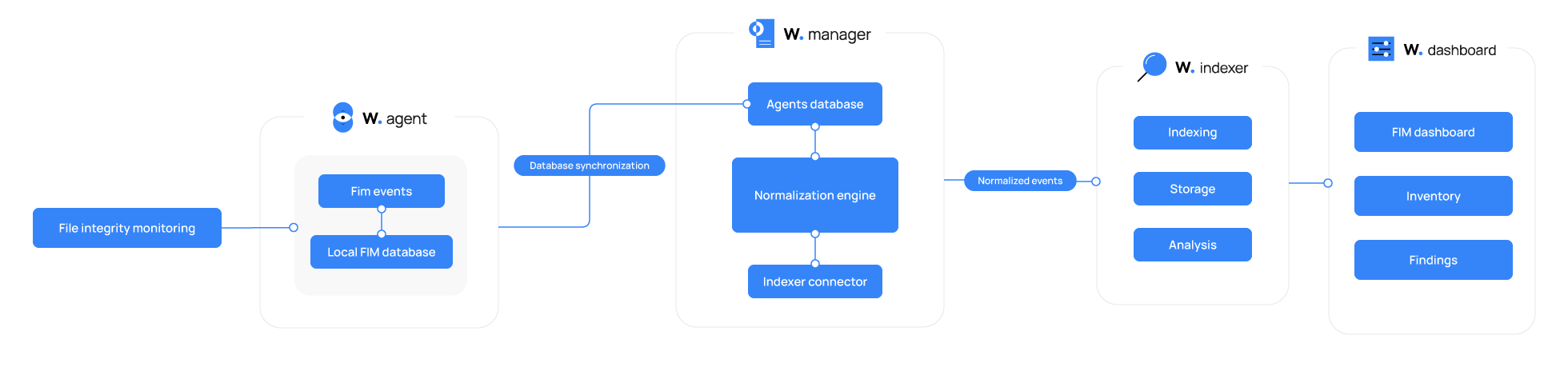
The Wazuh agent also synchronizes the current state of the monitored files with the Wazuh manager, which stores it in the wazuh-states-fim-files index of the Wazuh indexer. The Inventory tab of the File Integrity Monitoring module on the Wazuh dashboard shows this state.
The Wazuh manager processes the FIM events it receives from the Wazuh agents using the Wazuh normalization engine. The normalization engine converts the events into JSON documents that conform to the Wazuh Common Schema (WCS). The indexer connector component on the Wazuh manager then securely forwards the normalized events to the Wazuh indexer for indexing, storage, and threat detection.
On Windows, the FIM module monitors only files and directories located on local file systems. UNC network paths (for example, \\server\share\folder) and mapped drives (for example, Z:\folder) are not supported. Any such paths configured for monitoring are ignored and do not generate FIM events. This restriction helps mitigate security risks such as NetNTLMv2 hash theft and remote code execution that can arise when accessing files over network shares through NTLM authentication.