Remove agents
There are different ways to remove a Wazuh agent that is enrolled in the Wazuh manager. This includes using the Wazuh dashboard or querying the Wazuh manager API.
Remove agents using the Wazuh dashboard
You can remove Wazuh agents directly from the Wazuh dashboard.
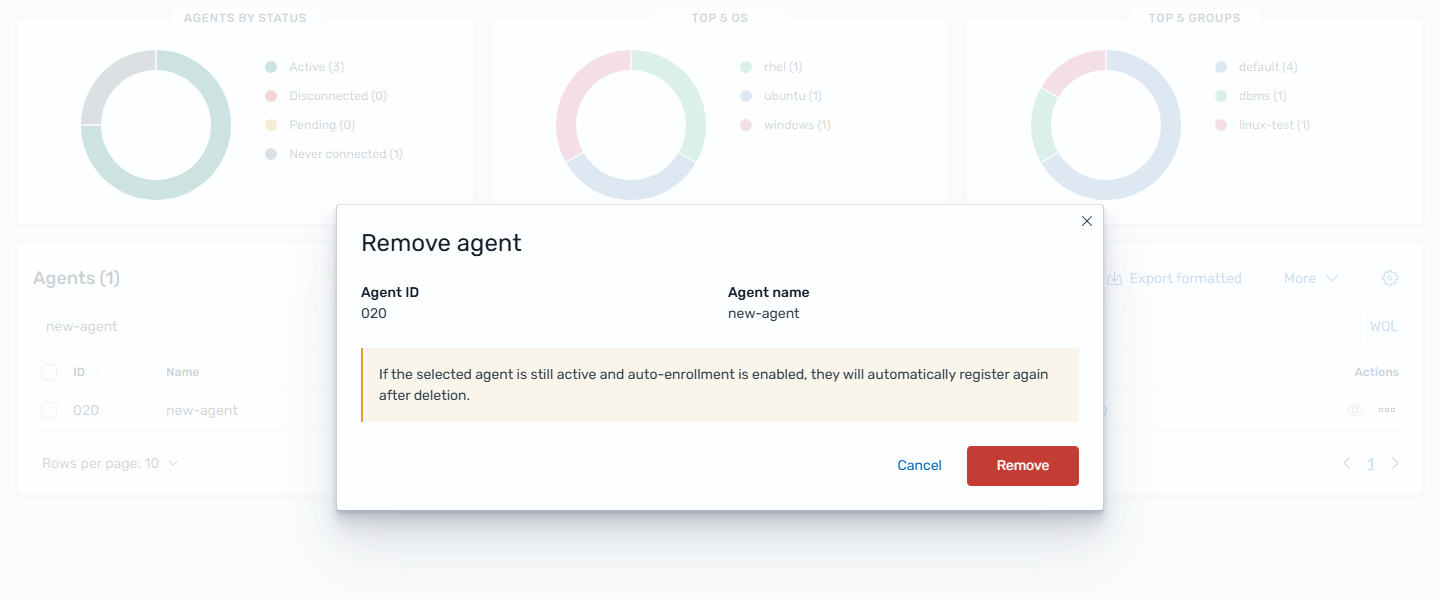
In the Wazuh dashboard, go to Agents management > Summary.
In the Actions column, click the selection icon for the Wazuh agent that you want to remove.
Select Remove.
When prompted, click Remove.
Remove agents using the Wazuh manager API
This section includes examples of using the DELETE /agents request to delete a list of agents or agents disconnected for a given period. Run these commands on the Wazuh manager master node, or on another host that can reach its API. After the Quickstart or an all-in-one installation with the installation assistant, the Wazuh manager API listens only on that host (127.0.0.1 and ::1), so run the commands there and use localhost as <WAZUH_MANAGER_ADDRESS>.
The examples use an authentication token. To get your token, replace <USER>:<PASSWORD> with your Wazuh manager API credentials, <WAZUH_MANAGER_ADDRESS> with the Wazuh manager IP address or fully qualified domain name (FQDN), and run the following command:
# TOKEN=$(curl -u <USER>:<PASSWORD> -k -X POST "https://<WAZUH_MANAGER_ADDRESS>:55000/security/user/authenticate?raw=true")
After an installation from packages or with the installation assistant, use the wazuh user. Its password is the WAZUH_MANAGER_API_PASSWORD value in /etc/wazuh-manager/export/credentials.env on the Wazuh manager master node, unless you changed it later with rbac_control. To print it, run this command:
# grep '^WAZUH_MANAGER_API_PASSWORD=' /etc/wazuh-manager/export/credentials.env | cut -d= -f2-
Note
You can reset the password for the Wazuh manager API user if you forget it.
Removing agents in a list
You can remove specific Wazuh agents using a list. Use the parameter agents_list to set a list of agent IDs separated by commas. For example, to remove the Wazuh agents with IDs 012, 014, and 016, run the following query:
# curl -k -X DELETE "https://<WAZUH_MANAGER_ADDRESS>:55000/agents?pretty=true&older_than=0s&agents_list=012,014,016&status=all" -H "Authorization: Bearer $TOKEN"
Replace <WAZUH_MANAGER_ADDRESS> with the IP address or FQDN of the Wazuh manager.
{
   "data": {
      "affected_items": [
         "012",
         "014",
         "016"
      ],
      "total_affected_items": 3,
      "total_failed_items": 0,
      "failed_items": []
   },
   "message": "All selected agents were deleted",
   "error": 0
}
Removing disconnected agents
You can remove Wazuh agents that never connected or agents that have been disconnected for a given period. Use the parameter older_than to set a period of no known activity. Use status to select the never connected and disconnected Wazuh agents. For example, to remove Wazuh agents inactive for more than 21 days, execute the following query:
# curl -k -X DELETE "https://<WAZUH_MANAGER_ADDRESS>:55000/agents?pretty=true&older_than=21d&agents_list=all&status=never_connected,disconnected" -H "Authorization: Bearer $TOKEN"
Replace <WAZUH_MANAGER_ADDRESS> with the IP address or FQDN of the Wazuh manager.
{
   "data": {
      "affected_items": [
         "003"
      ],
      "total_affected_items": 1,
      "total_failed_items": 0,
      "failed_items": []
   },
   "message": "All selected agents were deleted",
   "error": 0
}