Detecting hidden processes
Rootkit detection helps in identifying stealthy, kernel-level compromises that evade standard system monitoring tools. Wazuh Rootcheck module performs periodic scans on a monitored endpoint to detect signs of rootkits, hidden processes, and other host-based anomalies. In this use case, we show how Wazuh detects hidden processes created by a rootkit on a Linux endpoint. You deploy a kernel-mode rootkit on an Ubuntu endpoint. This rootkit hides from the kernel module list. It also hides selected processes from the ps utility. However, Wazuh detects it using the setsid(), getpid(), and kill() system calls.
Infrastructure
Endpoint |
Description |
|---|---|
Ubuntu 24.04 |
On this endpoint, download, compile, and load a rootkit. Then configure the Wazuh rootcheck module for anomaly detection. |
Configuration
Perform the following steps on the Ubuntu endpoint to emulate rootkit-like process-hiding behavior. The Wazuh agent runs a RootCheck scan based on the set <frequency> and detects the rootkit behavior.
Switch to the root user and update the kernel of this endpoint:
$ sudo su
# apt update
Install the packages required for building the rootkit:
# apt -y install gcc git
For the purpose of this POC, configure the Wazuh agent to run rootcheck scans every 2 minutes. In the
/var/ossec/etc/ossec.conffile, set thefrequencyoption in the<rootcheck>section to120:<rootcheck> <disabled>no</disabled> <check_files>yes</check_files> <check_trojans>yes</check_trojans> <check_dev>yes</check_dev> <check_sys>yes</check_sys> <check_pids>yes</check_pids> <check_ports>yes</check_ports> <check_if>yes</check_if> <!-- rootcheck execution frequency - every 12 hours by default --> <frequency>120</frequency> <rootkit_files>etc/shared/rootkit_files.txt</rootkit_files> <rootkit_trojans>etc/shared/rootkit_trojans.txt</rootkit_trojans> <skip_nfs>yes</skip_nfs> </rootcheck>
Restart the Wazuh agent to apply the changes:
# systemctl restart wazuh-agent
Attack emulation
We performed the following emulation on the monitored Ubuntu 24.04 endpoint:
Fetch the Diamorphine rootkit source code from GitHub:
# git clone https://github.com/m0nad/Diamorphine
Navigate to the Diamorphine directory and compile the source code:
# cd Diamorphine
# make
Load the rootkit kernel module:
# insmod diamorphine.ko
The kernel-level rootkit "Diamorphine" is now installed on the Ubuntu endpoint.
Note
Depending on the environment, the module sometimes fails to load or function properly. If you receive the error
insmod: ERROR: could not insert module diamorphine.ko: Invalid parametersin the last step; you can restart the Linux endpoint and try again. Sometimes it takes several tries for it to work.Run the kill signal
63with the PID of a random process running on the Ubuntu endpoint. This unhides the Diamorphine rootkit. By default, Diamorphine hides itself so we do not detect it by running thelsmodcommand. Try it out:# lsmod | grep diamorphine # kill -63 509 # lsmod | grep diamorphine
The command output looks similar to this:
diamorphine 13155 0
When using these last commands, you can expect an empty output. In the case of Diamorphine, any kill signal 63 sent to any process, whether it exists or not, toggles the Diamorphine kernel module to hide or unhide.
Run the following commands to see how the
rsyslogdprocess is first visible and then no longer visible. This rootkit allows you to hide selected processes from thepscommand. Sending a kill signal 31 hides or unhides any process:# ps auxw | grep rsyslogd | grep -v grep
The command output looks similar to this:
root 732 0.0 0.7 214452 3572 ? Ssl 14:53 0:00 /usr/sbin/rsyslogd -n
# kill -31 <PID_OF_RSYSLOGD>
# ps auxw | grep rsyslog | grep -v grep
Replace
<PID_OF_RSYSLOGD>with the PID retrieved from the previous command
When using this last command, you can expect an empty output. The next rootcheck scan runs and alerts us about the rsyslogd process, which was hidden with the Diamorphine rootkit.
Visualize the findings
You can visualize the findings in the Wazuh dashboard. To do this:
Navigate to the Threat intelligence > Threat Hunting dashboard and add the filters in the search bar to query the findings.
wazuh.integration.name: wazuh-rootcheck
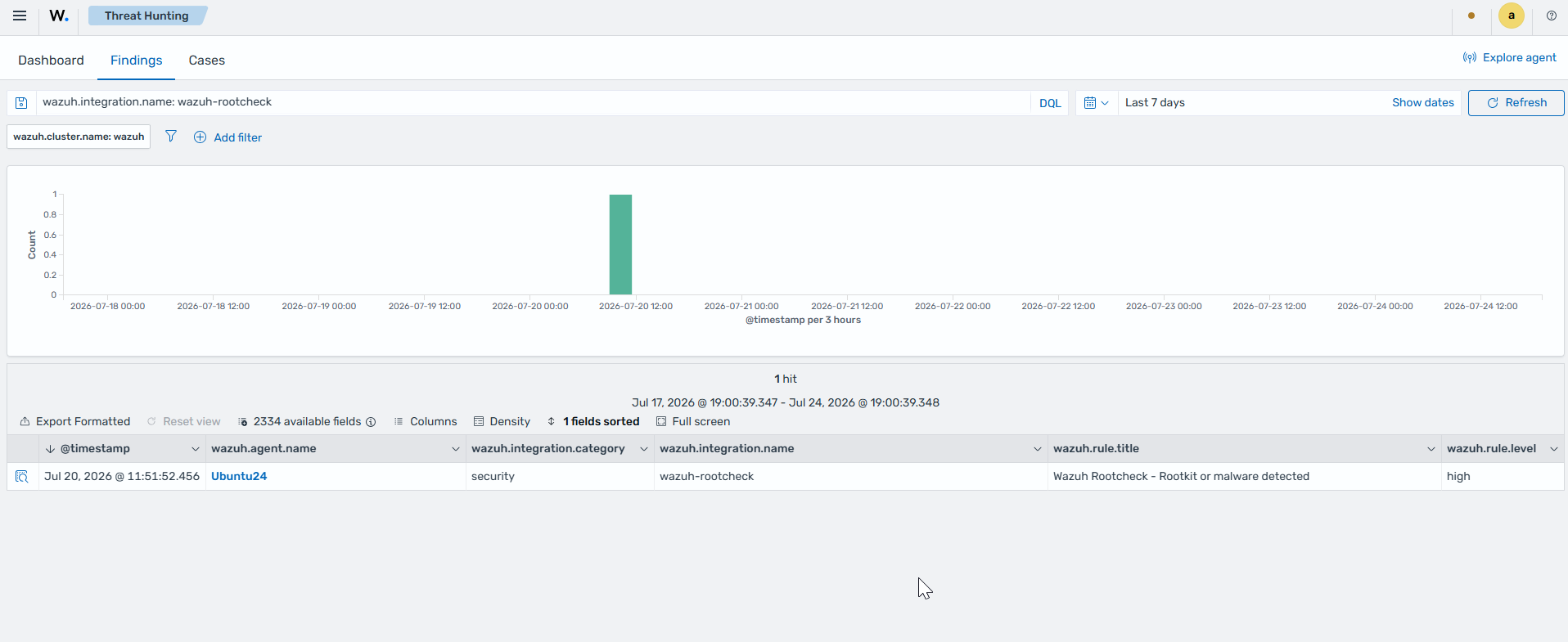
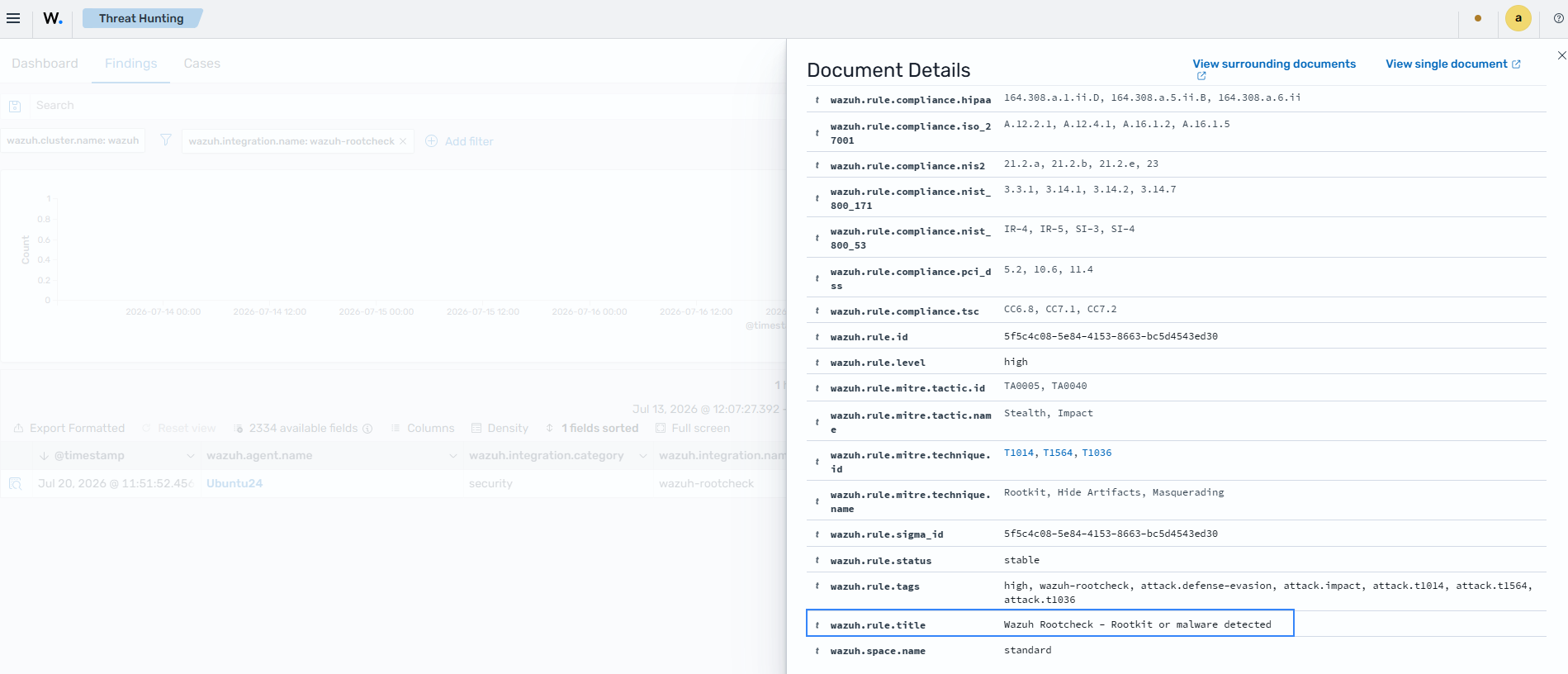
Click the magnifying glass icon to view the details of the findings.
Remember, if you run the same kill -31 command as before against rsyslogd, the rsyslogd process becomes visible again. The subsequent rootcheck scan would no longer generate findings about this event.